How to fit a rucksack
RevolutionRace
1min
Updated: 29 October 2026
Published 29 October 2026
A bad fit doesn’t just slow you down. It can also make every step harder than it needs to be. This guide on how to fit a rucksack walks you through how to measure your torso, adjust your straps in the right order and get a fit that carries the weight for you.
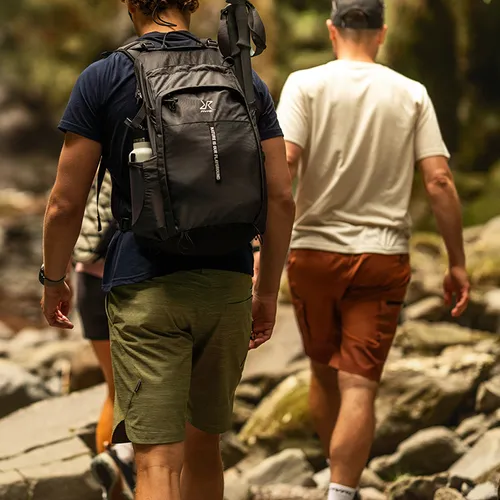
A good rucksack shouldn’t just carry your kit – it should carry it well. Get the fit wrong and even a light load starts to grind you down within the first hour.
Most people size by height. It’s an understandable assumption, but it’s the first mistake. What actually matters is your torso length. If you’ve never measured it, you might have been carrying the wrong size for years. But we’re here to help you with that!
Start with your torso, not your height
Torso length is the distance from the base of your neck to the top of your hip bones, and it has nothing to do with how tall you are. Two people who are both 180 cm can have torso lengths that differ by several centimetres, putting them in completely different size categories.
Here’s how to measure it:
Tilt your head forward and find the bony bump at the base of your neck (your C7 vertebra)
Place your hands on your hips and draw an imaginary line across the top of your hip bones
Measure the distance between those two points
That number is your torso length. Match it to the size guide for whichever pack you’re considering, and you’re already most of the way there.
How a well-fitted rucksack should feel
Once you have the right size, it’s about how you adjust it. A properly fitted pack sits close to your back without pulling away, transfers most of the weight onto your hips and stays stable when you move. Not like something you’re constantly fighting to keep in place. Supported, not hanging. That’s the benchmark.
Fitting your rucksack, step by step
Order matters here. Work through the straps in the wrong sequence and you’ll undo each adjustment as you make the next one.
Hip belt first
Position it on top of your hip bones, not around your waist. Tighten until it’s snug. Around 70–80% of the pack’s weight should sit here, not on your shoulders.Adjust the shoulder straps
Pull them down and back so they follow the curve of your shoulders without gaps. The straps are there to stabilise the pack, not to bear the load.Tighten the load lifters
These are the small straps running from the top of each shoulder strap up to the pack. Pull them gently until the pack tilts slightly towards your back. A degree or two is enough.Secure the sternum strap
Clip across your chest and tighten just enough to stop the shoulder straps from sliding outwards. It shouldn’t feel restrictive.
Load up the pack and walk around. If everything moves together with you rather than the pack shifting independently, you’ve got it right.
The 20% rule (and why it matters)
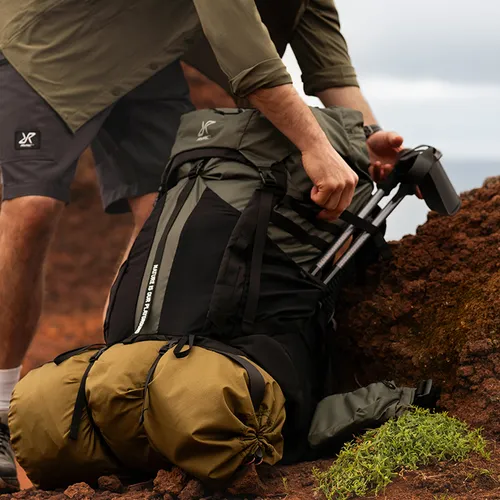
A useful benchmark: your loaded pack should weigh no more than about 20% of your body weight. But if it feels heavier than expected, the problem is usually fit rather than load. A well-adjusted pack distributes weight so efficiently that it genuinely feels lighter than it is.
Signs your rucksack doesn’t fit properly
Even after adjusting, your body will tell you if something’s off.
Watch for:
Shoulder pain or numbness
Pressure on your lower back
The pack pulling away from your body
Constant shifting while walking
These are clear signs your rucksack fit needs adjusting, or resizing.
How to tell if a rucksack is too big
Size is usually the culprit when it comes to a proper rucksack fit, so it’s important not to underestimate it.
Your backpack may be too big if:
The hip belt can’t sit correctly on your hips
The shoulder straps feel too long or loose
The pack extends too far above your shoulders
If you’re unsure how to fit a rucksack, sizing is often the first thing to check.
Small adjustments, big difference
Fitting a rucksack isn’t a one-time setup. Straps loosen with movement, terrain changes how a load feels, and a pack you adjusted at the start of the trail rarely feels the same by the top of a climb.
A few habits that help:
Re-tighten straps after the first 10–15 minutes of walking
Go a little tighter on downhill sections to stop the pack shifting forward
Rebalance the weight inside if the load starts to feel uneven
The more time you spend in a well-fitted pack, the more instinctive those adjustments become.
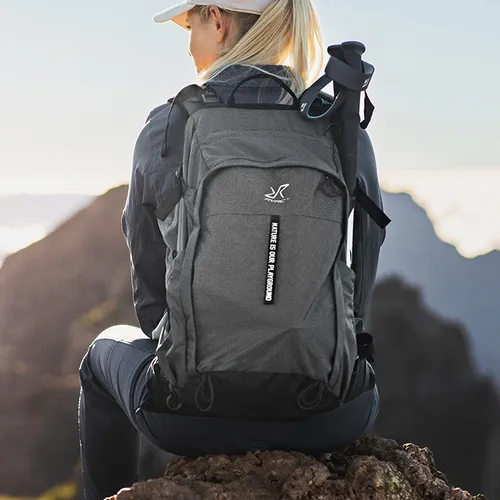
Find your perfect fit
Right, so now you know how to fit your rucksack properly. But, a good fit is half the work. A good fit is half the work. Explore our rucksacks to find a model that matches your needs, and if you’re still deciding on size or style, our guide on how to choose a rucksack is a good place to start.